Photo of the Day


The Batmobile from the Tim Burton-directed superhero film “Batman” is on view. The film—starring Michael Keaton as Batman and Jack Nicholson as the Joker—was the first installment of Warner Bros.’s initial “Batman (1989)” film series. Originally built on the chassis of a Chevrolet Impala, the Batmobile was designed by Anton Furst, drawing inspiration from Salt Flat Racers and the Corvette Stingrays of the 1950’s and reflecting the Art Deco influences that Burton’s depicted in his Gotham City. The vehicle is on loan from Warner Bros.

Lynda Carter’s costume from her portrayal of Wonder Woman in the 1970s television series

Shield used by Chris Evans as Captain America in Captain America:The Winter Soldier


Singer Industrial Sewing-Mechanic head from 1917, Tailor's Scissors

Horatio Jackson paid $3,000 for the car https://americanhistory.si.edu/collections/search/object/nmah_843068

In Idaho, Jackson acquired Bud, and the bulldog accompanied the pioneering motorists to the East Coast. Churning dust irritated Bud’s eyes, and Jackson purchased this pair of goggles for him.
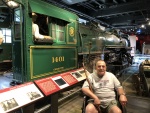
Smithsonian’s famous locomotive No. 1401, built in 1926 in Richmond, Virginia, and which from that year until 1952 pulled the Southern Railway’s most important passenger trains between Greenville, South Carolina and Salisbury. Surrounding the 92-foot long 1401


Made by Augustus Saint-Gaudens after Leonard Volk’s 1860 original As the United States expanded westward, Americans debated and fought over the issue of allowing slavery in the new lands. Abraham Lincoln rose to national prominence after delivering a speech at the Cooper Union in February 1860 arguing against the extension of slavery. Following his election that year, seven southern states, fearing that he was anti-slavery, seceded from the Union.

Patent issued 1794 In Whitney’s day, inventors sent paperwork, a model, and $30 to the secretary of state (then Thomas Jefferson) in order to obtain a patent. After a fire destroyed the Patent Office and its contents in 1836, officials re-created some of the records and models. This model may have been based on existing gins as well as on other models made by Whitney.

Factory machine for making buttonholes American goods were increasingly made in factories as companies adopted large-scale, standardized production methods in the late 1800s. Specialized machines took the place of manual tasks—such as sewing buttonholes for ready-made clothing—speeding up the work to meet the growing demands of a nation of consumers. The advent of more simply constructed women’s apparel in the 1890s gave a further boost to the clothing industry.

This blue wool coat is part of a suit of regimentals made for George Washington in 1789. It has a buff wool rise and fall collar, buff cuffs and lapels, and buff lining; there is a row of yellow metal buttons on each lapel, as well as on each cuff. The waistcoat and breeches are matching buff wool,with gilt buttons.

This uniform was worn by George Washington from 1789 until his death in 1799; the small clothes or breeches and waistcoat, date from the revolutionary period.


Physical DescriptionHanger-type sword of forged steel with grooved blade. Grip of green-dyed ivory with silver strip decoration. Leather scabbard with silver trim.Specific HistoryGeorge Washington wore this simple hanger as his battle sword while serving as commander of the Continental army during the Revolutionary War. Made in Fishkill, New York, by John Bailey, an immigrant cutler from Sheffield, England, the sword has a slightly curved, grooved steel blade, silver-mounted cross guard and pommel, and a green ivory grip.The sword was inherited by Washington’s nephew, Samuel T. Washington, an army captain. In his will, Washington admonished his nephew to draw the sword only "in self-defense or in the defense of [the] country and its rights.” Samuel's son donated the sword to the United States government in 1843.


Surgical Kit, Canister for ether, crutches, prosthetic limb

along with Colt Walker Pistol

sword and scabbard and Campaign hat https://americanhistory.si.edu/collections/search/object/nmah_438751https://americanhistory.si.edu/collections/search/object/nmah_445155

On April 9, 1865, General Ulysses S. Grant and General Robert E. Lee met in the home of Wilmer McLean at Appomattox Court House, Virginia, to negotiate the surrender of the Confederate Army of Northern Virginia to the United States Army. Sitting in the chair on the right, Grant discussed the fate of Lee's troops. Then, leaning over the oval table, he drafted and signed the final terms of surrender. While there were still Confederate troops in the field under other commanders, Lee's surrender effectively marked the end of the Civil War. Union officers, recognizing the significance of the event, individually took pieces of furniture as souvenirs. General E. W. Whitaker grabbed Lee's chair, General Henry Capehart claimed Grant's chair, and General Philip Sheridan took the table and presented it to the wife of Major General George Amstrong Custer. In three separate donations, by 1915, these items were reunited at the Smithsonian Institution.


This horse was presented to General Philip Sheridan by the officers of the Second Michigan Cavalry in 1862. He was three years old, was jet black with three white fetlocks, and stood 16 hands high. Originally called "Rienzi" after the town of Rienzi, Mississippi, his name was changed to "Winchester" by Sheridan after he carried Sheridan on his famous ride from Winchester, Virginia, to Cedar Creek, Virginia on October 19, 1864, in time to rally his troops and turn almost certain defeat into victory. While Cedar Creek was his most famous engagement, Winchester and Sheridan were actually together for more than forty others. Winchester was even present at Appomattox Courthouse in April 1865 for the official surrender of the Confederate Army.


A stained glass window from the Victor Company’s headquarters in Camden, New Jersey, featuring “Nipper,” the iconic dog listening to his master’s recorded voice

the red shoes from the iconic 1939 movie


At six feet four inches tall, Lincoln towered over most of his contemporaries. He chose to stand out even more by wearing high top hats. He acquired this hat from J. Y. Davis, a Washington hat maker. Lincoln had the black silk mourning band added in remembrance of his son Willie. No one knows when he obtained the hat, or how often he wore it. The last time he put it on was to go to Ford’s Theatre on April 14, 1865


